After yesterday's second We Can't All Be Astronauts comic by Line And A Dot, I just happened to be browsing through some of (MS Paint Adventures creator) Andrew Hussie's other web comics, when I stumbled across a couple of awesome, deceptively simple single-premise series that made me chortle like the mentally subnormal.
'Inappropriate Time For Ham' is exactly what it sounds like - a series of cartoon depictions of times when ham is inappropriate.
And my personal favourite (as if you care, you glib bastards):
The second series is called 'A Steep Price For Pie', and... well, you'll get the idea.
You can see more here. I suppose one of the reasons I like these is that I can imagine the conversation that spawned them. You know, one of those times where you're chatting in the bar with your mates, and you hit upon a rich comedy seam, and everybody starts riffing off it, and you're all pissing yourselves laughing. I just get the impression he was sniggering just making these up. And once you've got the premise, you can really go to town. It's like when you come up with a great conceit for a list poem, and you spend the next couple of hours just brainstorming every single iteration of the idea: 'Right, so in this poem I've made a crazy wish, and my mouth is now an anus and my anus is now a gun? What would be the hilarious consequences of that?' I'm now busily imagining comics in which not everyone gets to be an astronaut. I daresay I'll put my infantile drawing abilities into practice sooner or later, and commit some to this here blog. Just you wait.
Hooray! Line And A Dot has released a second nose-tingling installment of We Can't All Be Astronauts, the graphic novel adaptation (the text version of which is TOTALLY available to pre-order on Amazon!). Click on the pic below for a bigger image, and click here for part one.
So, a while back, the ever-awesome Metafilter put me onto this exchange, between gaming legend Tim Schafer - who worked on Monkey Island, Day of the Tentacle and Grim Fandago, amongst others - and joystiq.com. In it, Tim and his interviewers turn a simple email exchange into an adlibbed mini text adventure.
It's a lovely, rich format for collaborative storytelling. Joe Dunthorne tried his hand at something similar, adopting the old Choose Your Own Adventure 'forking paths' style with his middle-class adventure 'You Are Happy', which you can play on his website. He's performed it a few times as part of our show about video games and hiding from reality, Infinite Lives, getting audience members to choose what to do next. I've particularly enjoyed watching the supporting schtick develop - one thing a text adventure can't do is demand that the player provide an explanation for their choice of path.
All of which is a preamble to this. Hey. You should go read MS Paint Adventures. After an entire year of inputs, the latest adventure, Problem Sleuth, is finally complete. When I read the last few frames, I felt kind of choked up and elated all at once.
Basically, it's an interactive webcomic, presented in the style of the Sierra-style text adventure/point n' click hybrids, like King's Quest or Leisure Suit Larry. Readers post suggested commands on a blog - e.g. 'Examine phone', 'Open safe', 'Get key', etc - then writer and artist Andrew Hussie picks one to draw next and develop the story.
The eponymous Problem Sleuth starts off locked in his office, and the first order of business is working out how to escape. Like any great storyteller, Mr Hussie's awesome at subverting expectation. Here, someone suggests punching through the office door's glass window:
Only to discover that it's not glass, but a piece of paper with his initials written backwards on it:
Watching the dynamic between Andrew and his audience develop is fascinating. As their attempts to solve the puzzle grow more and more creative, so his tactics for frustrating their attempts become increasingly elaborate. The result is a wonderful - if tortuous - piece of collaborative improv, full of cool narrative flourishes that draw from a plethora of disparate cultural sources to make something weird and technicolour and awesome. I don't want to spoil it for you, but suffice to say that soon there are multiple player characters, a host of mighty allies and a nasty-ass monster horde to be defeated. You probably won't have the stamina to read it all in a single sitting (it is a year's worth of posts, after all), but you can Save and Load your progress from the buttons just beneath the pictures. Click each command to advance to the next frame.
The shrewder amongst you may have discerned that this blog, far from being a innocently whimsical aggregation of my daily musings, is in fact a massive shill for my forthcoming non-fiction debut, We Can't All Be Astronauts - which comes out on June 4, and you can preorder now (at a substantial discount). If you're thinking of getting the book when it's released, preordering it would help me out. Preorders confuse my publisher into believing that there's a colossal groundswell of anticipation amongst the reading public. Although frankly, if you're thinking of reading it all, you're already my best friend, in which case I can only weep with reverence and hope you enjoy it.
When people ask me what the book's about, I struggle a bit. Do I give a mini-synopsis? Do I go for the elevator pitch? Do I talk about themes? Do I turn one of the sections into an anecdote? What is it about, exactly?
It's at times like this you need someone with a little distance from the project to step in. Fortunately, the interdisciplinary sorceress Line and a Dot has thrust the book into the crucible of her creative mind, burning away all the ancillary prattle until only its purest essence remains. This comic sums up what I suppose you'd call the 'soul' of We Can't All Be Astronauts far better than any amount of my discursive verbiage could ever hope to. Click on the image for a bigger pic.
Oh, and by the way, you should listen to Line and a Dot's songs. I've been a fan for years. You're late to the party.
Last week, I spoke to Dockers MC. This week, it's the turn of the prodigiously talented Polarbear.
How did you get into performance poetry?
My best mate told me it was just rhyming without a beat and that I should get on stage at a poetry night in Birmingham. He had no idea what it was really and neither did I. I was first to perform that night and if I hadn’t been I probably wouldn’t have got up.
It definitely wasn’t a bunch a rhymers spitting to no beat.
How would you describe your work?
Stories about people and things with a nod of the cap to my first cultural love.
Do you think there's a difference between 'page' and 'performance' poetry? If so, what?
There are people who write very well, whose work loses something in performance and there are people who perform well who seem weak on the page. I’m a big believer in the adage ‘good is good’ and that the best can cut it either way.
None of that is an answer to the question really. Yes, I think there is a difference. I think that when you are speaking your work on stage there are demands in terms of immediacy, delivery and personality that are not present in the same way for page poems. On the page, words work without the packaging of a stranger and must stand on their own. The goal of both is connection and imagery plays a big part. For me it becomes clear early on in the writing whether a piece is meant to be spoken or read.
Why should someone come to a performance poetry gig?
To remember that words and their use can actually be fun, powerful and important.
What do you think your best poem is, and why?
I’m selfish. I don’t share anything until I’m happy with it and when that point comes I think it’s good. Once something is finished and I’ve shared it how I wanted to I move on. I think this is the main reason why I’m probably not cut out to be a performance poet because I get no real pleasure from performing the same pieces again and again.
I think that the best piece I have written is called ‘Fingers’. It was the first and only time I have attempted to sum up a direct personal sentiment and the fact that I’ve never felt to return to the subject matter directly speaks for itself. ‘If I Cover My Nose You Can’t See Me’ was pretty satisfying as it was something that I hadn’t seen done in the realms of spoken word and I’m very proud of the story. The new piece I’m writing currently is looking like it could be alright too.
If you could nick one other person's poem and claim it as your own, which poem would it be, and why?
For me so much of the enjoyment, disgust or indifference I have towards performed pieces is down to my own reactionary thoughts as to an artist's motivations and personality. I genuinely believe there are people who I wouldn’t enjoy no matter what they did and others find interesting regardless. With that in mind anything I do like a lot feels intrinsically linked to the person I witnessed speaking it and couldn’t imagine myself speaking. That’s a shit diplomatic answer which although true is really boring.
Kim Trusty wrote a piece called ‘A Quiet Heart’ and I’d steal that from her sleeping fingers.
What typifies bad performance poetry to you?
A self-satisfied rant in a desperate need for applause.
What do you think of the state of the UK performance poetry scene at the moment? Is it okay to talk about a 'scene', or is that a bit unhelpful?
To be honest I’m not sure. I get asked this a lot and give pretty much the same answer every time. I don’t really go to nights and watch stuff. I don’t really feel part of any scene. I actually perform pretty rarely and so the only thing I can say is that due to the opportunities that have a risen since I started doing this in 2005 I now earn a living from writing, performing and teaching about writing and performing so something must be ok.
Oh, and there’s too many frustrated comedians and crap rappers.
Tell us about a particularly memorable reaction you've had to your work.
I genuinely am constantly surprised by reactions. I’ve not really had a stinker of an experience so it’ll have to be positive ones. The most vocal are usually from people who were either a) not expecting to enjoy something called ‘poetry’ or b) not even expecting to see a stranger just talking on stage.
I love the sink or swim nature of what we do. The raw immediacy of a setting where attention is not guaranteed is something that I think a lot of artists shy away from and hide behind the idea that their work has moved on.
I believe I'm right in saying you're just finishing a run of your debut full-length solo show, If I Cover My Nose You Can't See Me. Can you just say a little bit on what the show was about and how the experience was for you? You had Goonism producing visuals live for the show - how did you come to include that element and how did you feel it worked out?
The story is about how we create things to fill gaps left by other things and what happens to what we used to want. It revolves around the lives of two characters who live in a tower block and have something they're trying to do.
I'm really proud of the piece. It was a story that I'd been thinking about for a while and I knew what i wanted it to be and what i wanted to say so i just started and it sorted itself out. I'm happy that it is entertaining enough for people to enjoy live, but also the nerd in me is smiling at the detail that is there both in terms of content and form. If I go on I'm gonna sound like a knob.
The best part of the experience was working with Yael Shavit, who both directed and developed the piece with me. It was so important for me for it to exist in it's own right rather than serve or be served by my Polarbear persona and we achieved that. To be in a story when you tell it and hold people for an hour but also let them leave with questions was a goal I think we achieved.
Once the story had been written I wanted to play with what we could do regarding the experience of seeing it live. I'm not big on cross art collaborations sharing a stage (for my own work anyway) and knew Goonism from seeing Secret Wars (live artwork battling event that tours all over the world). I loved his work. the emotive simplicity and basic moodiness of his characters felt perfect for the story. i approached him and he liked the story and was interested in exploring narrative in his work so we started playing around. he likes drawing live for an audience and it's magical to watch a white wall get turned into what is in effect a huge movie still. So when you come to see the show, we take over the venue. Goonism artwork all around the space and foyer, him drawing live outside while i speak the story in the space so when you come out after the story you get to watch him create a scene from the film you just listened to. It's pretty exciting and really feels like you're stepping into the world of the characters and that's Goonism's doing as much as mine. We have begun developing a graphic Novel of the story but it's such a long process it'll be ages. proper ages.
So yeah. I'm pleased. As we say in Brum, it's not shit.
(via Metafilter) My favourite website, the community blog Metafilter, has yet again led me to something great online that really cheered me up. Tiny Art Director is a blog where Bill Zeman's little daughter requests pictures, which he then draws for her. Each picture is accompanied by a description of the brief, and the Tiny Art Director's response. She nearly always hates them. Here, for instance, is her reaction to the commission the picture of crocodiles:
The Brief: Crocodiles Preliminary Sketch (no longer extant): Upon seeing the preliminary sketch, the art director, in a rather unprofessional outburst, collapsed on the floor sobbing and screaming. The Critique: The back is so so so bad I don't even want to look at it! You always do that to the crocodile's back! Job Status: Rejected and Destroyed
The Tiny Art Director has some favoured themes - dinosaurs feature heavily - but her true talent as a visionary is made manifest in what I believe to be the high watermark of all Western culture: the Poo-Poo Airplane.
Her commissions have been collected into a book, which is available via the blog - perfect for the discerning aesthete's coffee table or nursery.
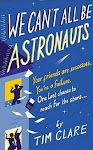
My first book, We Can't All Be Astronauts, is out now from Ebury Press. Buy it here.
About the Author
Tim Clare is a writer, stand-up poet and musician. His autobiographical book about having one last shot at your dreams, We Can’t All Be Astronauts, won Best Biography/Memoir at the East Anglian Book Awards 2009. It is out now from Ebury Press. He has written for the Guardian, the Times and the Independent, and has appeared on BBC2, Radio 1, 2, 4 and 6. In 2005 he presented the Channel 4 series ‘How To Get A Book Deal’. He is a regular performer at many festivals including Glastonbury, Leeds and Reading, and Latitude. To get We Can’t All Be Astronauts click here. To check out his latest gig schedule, click here. To get in touch, drop him a line at: joshureplied[at]yahoo[dot]co[dot]uk


 And my personal favourite (as if you care, you glib bastards):




 Posts
Posts

